hello all,
Tuesday, 12 May 2009
Last Post
hello all,
Wednesday, 6 May 2009
Dear Gherkin:)
Tuesday, 5 May 2009
More Photos
Hey I asked my friend to take some photos of stuff he thought was interesting and/or funny, I didn't get him to use the arrow as by not having him use the arrow it shows people there are no set rules for submitting photos.
Saturday, 18 April 2009
Clock Sounds
20090405.clock.stereo.dry.wav, 20090405.clock.mono.dry.wav and Grandfather clock.wav can all be found on the following website http://www.freesound.org/searchText.php.
For some background music I found this track which I felt sounded a little like a countdown as well as being quite light and soft.
If we used this track for our home page, rather than have it playing in the background and giving the user the choice to turn it on or off we could play it for a few seconds and have it automatically end in doing so creating a sound logo.
This is the sound logo for Mercedes Benz and as you can see it's just seconds long.
As the song posted above is quite long I found some shorter audio tracks which I have posted here.
Countdown Sound
An acoustic sound
A blues number
Matthew
Tuesday, 31 March 2009
More stuff.


This would be used as a menu page for our mission statement, the sizing is wrong but you get the overall idea. I have also included some pieces of art which we would use and I think it would be best to combine these with some of the ones that Juan had posted earlier so that we have contemporary and classical styles. Though I know we're supposed to be quite positive I do think that these images make a nice contrast to the positivity we will be producing through the photographs, as well as the lighter tone of Juan's writing.
Matthew.
More stuff!


The stupid blog wouldn't allow me to load any more stuff onto the blog, so I have to make a new post.
So, here are some more images, the horizontal arrow as well as some designs with the new logo inside the frame.
Enjoy.
OMG, this stupid thing isn't letting me upload anything else, I'll post another blog and put the other images into that.
Bye.
Matthew.
The Arrow in use.
Wednesday, 25 March 2009
Some countdown examples
I will continue search for a perfetc countdown...
By the way, this one comes from http://www.countdownr.com/
another one is
EB
New frame
I reall
y like the images- especially the strawberry one!:)I reconsidered the names and also think it's good if we stick with VANITAS. It sounds nice and actually I agree with your arguments that it would fit the theoretical content.
Yesterday we agreed on the logo that would be made using font from dafont.com and it would look like the image on the left. The font name is BarMKode Inverse and it was designed by Manfred Klein. It gives nice effect and resembles a stylized bar code which neatly links with the ideas of consumptionism and cultur
e jamming etc.
We'll see how it looks with the rest of the interface.Rearding the frame- I found a nice one, royalty free one from stock.xchng. If we use it we ensure that there will be no fuss as it is free to use. The previous frame I showed as an example was from Google Images and its copyright status was not clear.
It's cute, isnt it? It will look like this in Flash frame of the size we agreed to use (850x650px) so now the space for the interactive will be around 688x503px.
see you on Tuesday at 1pm.
EB
Monday, 23 March 2009
Responses
+3035692336_59053f3351.jpg)
+o_318246524.jpg)
+0703_still2.jpg)
+080414_xray3.jpg)
+Everyday_Colour_by_purplepawn.jpg)
+1174144412.jpg)
+Against-Modern-Art--still-life.jpg)
Bonjour y’all,
So,
Matthew – not sure if you’ll found this useful but i looked around for a few examples of what i thought was more in keeping with the joyful transience theme:
Ewa – i see no reason why we can’t use parts of Epicurus in our project but i’d very much downplay other parts of it, as i think i said the associations with nihilism are just a touch too unpalatable for some, and there’s really no need to potentially alienate certain – probably religious – groups. Just a concern is all. Moving on, i quite like the vanitas name, but if you’re not sure we should explore some alternatives. Not to be critical about your name suggestions, but do we really want to market ourselves in this way? It just doesn’t seem to fit our purpose; i saw us very much more highlighting the absurdities of advertising and its anything for attention rationale.
as for i,
Juan PdR.
Border for inside the frame.
Wednesday, 18 March 2009
Some more

I think it will be original if we stick with the idea of vanitas motive in painting.
Useful source of images- Olga's Gallery, mainly under the section on baroque.
Best,
EB
Some more ideas; NAME REVISITED
First of all, I like the ideas of both Seneka and Epicurus. Why do not we go for both of them? As I suggested, we can have a "shop with ideas" where our audience could browse and buy our "products", i.e. our selections of philospohies&theories regarding simple life as opposed to conspicuous consumption.
I have a visual idea for interactive images with a scrollbar. When image gets clicked a product description comes up on the side- drafts will be posted ASAP to give more detailed view. I did such Flash tutorial some time ago and it was fairly easy to apply.
Secondly, I came up with some ideas for a name of the product (somehow I don't really feel happy with simple VANITAS).
Some theories first.
According to Marcel Danesi (2006) the more associations a name causes, the higher the connotative index (CI). In order to check what is CI of a particular brand cosumers are asked what they connote the name with. As Danesi writes, the higher CI, the greater its psychological force.
What is more, there are some features which help in improving the CI. For instance, a letter X in the name, such as in EXXON (previously ESSO). According to Danesi's research, new name "sounds like it's going to last", "is exciting", "sounds like adventure" (p.39). On the contrary, the previous name- ESSO was described as "soft", "smooth" and "steady" and it evoked much less associations.
Danesi (2006) deploys several examples to emphasise that "the brand names with letter X seem to tap into the reservoir of connotative meanings in a largely unconscious fashion" (p.41). "The letter X is associated with youth, danger, and all the X-citing things" (p.40). Danesi (2006) provides a list of cultural meanings associated with letter X, for instance thge Roman number ten, a symbol for Christ or the unknown especially in mathematics. Similarly letter Z- it is also "power-sounding".
Brand names can be also amalgams consisting "of two or more morphemic parts, each one suggestive of a specific word." For example, Fruitopia=Fruit=Utopia or ViraMax= Maximum Virility (Danesi,2006:50-1).
Baring in mind the above, here my candidates:
XTRAVANZ- extra+vanity+Z; brings associations with extravagant, extravaganza. I quite like it.
VANITRA, VANTRA, VANITRANZ= vanitas/vanity+transience+Z to make it look
VANITAZ- its obvious; sounds a bit street-wise
XTRAVAN- extra+vanitas/vanity, googled it and there is already a company named in this way. It's not surprising that they hire "xtra" vans:)
VANX- vanity+X
TRAVANX- transience+vanity+X
If I come with some more, I will post them here as well. Please think about these and give a shout when you come across the most suitable name.
Best,
EB
Tuesday, 17 March 2009
Designs and Icons
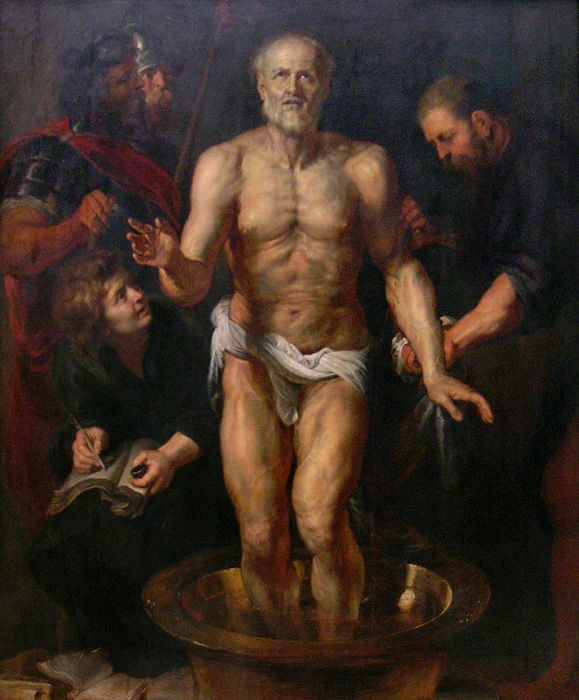
Haven't written for a while, after our meeting I thought it might be good if we used some images of Seneca as it would fit in with this theme of using motifs from Art as well as adopting some of his philosophies. I'll photo shop some stuff by next week, but these are the sort's of images I would be using. Here is a link to Peter Paul Rubens Death of Seneca. This is a link to a database of images of portraits of a number of philosophers as well as attempts to picture their theories. Went onto the Transience/Vanitas section of the Rijks Museum website to get a feel for some of the imagery we'd need. I'll get to work with desgining the look of our pages this week and will post some of my work as and when I finish it.
See you next week.
Matthew.
Monday, 16 March 2009
Wikis, Metaphysics and the search for the right sound.
Ok, first things first. I’ve set us up a new email address and wiki using the vanitas name, we can always change these later.
We are now reachable via:
vanitas@live.co.uk (the password is the same as for the blog)
and
vanitas.pbwiki.com
There’s not much going on there at the moment but i’ll keep playing around until i get the hang of it. Also , I’ve been looking around for some ambient music to set the mood for our web pages but so far found nothing i really like, but theses look like promising sites to dig around in: www.royaltyfreemusic.com and www.estockmusic.com – i’ll keep looking.
And now to the nature of human existence; I’ve read up a little on Epicurus over the internet and this is what i’ve grasped from it so far: part of the human soul is dispersed throughout the human body, very much atomised amongst our corporal matter – indeed even making up part of our corporal matter. It is through these particles of human soul that we develop sensation – sight and touch and so on.
So then, there are three basic human desires/pleasures:
The natural – a desire for health, comfort and general wellbeing.
The natural and unnecessary – that which we merely find pleasant; smells, tastes etc.
The empty – those unattainable desires of human construction, wealth, fame, immortality and so on.
The main purpose of the soul, its route to happiness is to maximise its pleasures and minimise its pains; the empty desires very much being a cause for anxiety and pain and so ultimately misleading and harmful. – All very nice; take pleasure in the little things, happiness is all about moderation and appreciating what you have. Except, as the human soul is physically ingrained into the human body it ceases to exist when we do, there is no greater meaning or purpose to existence. Thus life should be free from worry and repercussions, but also, as this very much sounds like a kind of existential nihilism, where there is no objective right, wrong or valid means for authority; it may not be the best foundation for our project.
“How much you have lost through groundless sorrow, foolish joy, greedy desire, the seductions of society; how little of your life was left for you. You will realise that you are dying prematurely.”
(Seneca, 5 BC – 65 AD)
In the simplest terms Seneca thought that in life we all spend very little time living. In his view there is much less of a moral judgment or even spirituality, in essence we all waste our time in idleness, excessive leisure in which the value of such time is lost due to its abundance, or else we lose time through obsessive preoccupations, in terms of vice as well as material gain or social status. In short we are wasteful with the only commodity that is truly and objectively precocious – our time. It is something that through the pursuit of other perceived gains we spend freely for everyone else’s benefit except our own.
In the same way any concentration on the past is useless and all preoccupation with the future meaningless as it may never happen. “to what goal are you straining? The whole future lies in uncertainty: live immediately.” For Seneca, the only fair part about good fortune is that it comes and goes and so any happiness built upon fortune is unstable at best. The answer then, is to live in the immediate sensuality and spiritual pleasures of life; obsessive preoccupations over anything represent nothing more than wasted time.
Similar to Epicurus then, in many ways but just a little bit more palatable to conventional thought.
Juan PdR
Wednesday, 4 March 2009
No worries; metaphor for navigation?
we started work on the proposal and will send you for edition.
I found an interesting link which might be inspiring in creating the metaphor for navigation. Rijks Museum with loads of 17 century art- Click to see. Some sculls, candles, mirrors, books etc combined together in Photoshop and transformed into interactive bit in Flash? Don't you think this could be of value if we used some motives from the history of art?
Just an idea:)
Best,
EB
Tuesday, 3 March 2009
All Apologies
So, so sorry i couldn’t be there today, i would have given warning but it was kind of an unexpected occurrence.
If any of you would be kind enough to take me through any developments i missed i’d much appreciate it.
Juan PdR
Monday, 2 March 2009
The Good Fight
Hello,
I’ve been looking into setting up our own wiki and there are a couple of places that will allow us to create a pretty straightforward and basic wiki for free:
www.Wikispaces.com
www.Pbwiki.com
So far i like the look of the second better...maybe i’m just hungry.
Ok, so Jurgen Habermas. You should all be familiar with Public Spheres but as a quick run through. A public sphere is a somewhat imaginary zone in which all people, uninhibited and free from coercion can gather and discuss political issues and through debate achieve consensus and a kind of dialectical progression.
The early form of the public sphere developed in the coffee houses and salons of 16th/17thcentury Europe. Here, nobles and the upper classes gathered primarily to discuss art and literature but over time the conversation turned to the increasingly expanding and complicated (thus regulated) economic markets and so political issues became the staple of these early debates. This is important as it marked the shift from political power being something held before the people - as in the manner of lords and monarchs - to something that if not held by the people per se, then was validated by them in the manner of public opinion, which in a democratic sense adds legitimacy to that which it supports.
As the complexities of the trade markets grew pamphlets began to circulate to provide details on stock prices etc. Soon these same pamphlets included the opinion of their producers in ever greater detail and voila, the first newspapers were born. Soon all shades of opinion, all be it in a very narrow class of property owners, had a mouthpiece and a means to spread their side of the great polemic exchange. Alas, as civil bourgeois society developed there became ever more institutional/official ways to voice opposition and hold those in public office to account. And so those newspapers that survived were free to happily pursue a more commercially viable purpose. Opinions were disguised as facts, ideologies became centralised and generic and all in the name of a larger share in the market audience, which in turn brought in a higher pay cheque from advertising revenue.
Soon, newspapers and all resulting news media became dependant on commercial revenue and so largely abandoned the idea of opinions and debate. Where once public opinion was a messianic figure there was now only the god of publicity and the one way dialogue of consumerism. However, the net with it's ridiculously simple, anyone can publish anything approach promises a return to a more inclusive and fully formed public sphere but with the rise of interactive branding and viral marketing our battle isn’t just about saving an intellectual space from the colonisation of advertising, it’s about preserving the last potential vehicle for true democratic participation!!
Quite compelling, i think you’ll agree.
Juan PdR
Thursday, 26 February 2009
Logo game (buttons and cursor)
Name is Siobhan, and I'm new to gherkin productions :)
After the last meeting we were discussing to include a flash game whereby the user can manipulate, or change the logo themselves...
This I thought was a little ambitious however suggested we should create a panel of editing buttons which still allows the user to have some level of interactivity and control over the logos image.
Also to enhance this feeling of freedom and creative FUN, suggested changing the cursor to a paintbrush...
Found the Lynda login and password and a brilliant tutorial about how to change the cursor. The action script isn't too hard, so we could go through it on tuesday...
Will post again tomorrow about mcluhan
Siobhan
p.s sorry about the color, the other greens were too similar to yours and I thought it might get confusing...
Viral Advertising
This is going to be brief, I'll go into more details in our next meeting, in Henry Jenkins Convergence Culture he makes many similar comments regarding advertising as the ones you mentioned from Lucas and Dorrian.
He lists how traditional mediums (TV, radio etc) have lost their attraction to brands as being the main place to attract consumers and how many companies have placed more emphasis on the Internet to advertise their products.
He documents how Coca Cola have used the Internet to create "love marks" which represent how companies attempt "to break into peoples hearts and minds. In that order.. We're moving to ideas that elicit emotion and create connections". Coca Cola attempted to do this by including a section of their website "where consumers can share their own personal stories about their relationship with the product, stories that get organized around themes such as "romance" "reminders of family" " by doing so Coca Cola turns the memories of the public into a marketing pitch.
I don't know if you had noticed but Lande has posted some comments on the blog, one of which contains a link to this website which encourages users to make a wish, over the phone which the website then posts on its revolving wall. Users can post whatever they want from the ridiculous " i wish my husband didn't look so much like Bin Laden" to the supposedly sincere " i wish for world peace". Similar to what we mentioned on Tuesday as it doesn't offer a guideline for how or what people should wish for.
See you on Tuesday,
guess it wasn't really that brief then,
Matthew.
Wednesday, 25 February 2009
(Not that) Fresh Ideas
To start with, as Lucas and Dorrian (2006) wrote, the media landscape has changed recently and moved into more interactive and audience engaging. The advertising has also shifted from conventional brand communication such as television spot to approaches which collide with Public Relations. It is no longer a one-way communication in predictable venues; advertisers are now seeking to draw the attention of the people in new surprising ways. As a result, the consumer has become invited to become involved "in something relatively new between the advertiser and consumer: a conversation" (Lucas and Dorrian, 2006:18; emphasis added).
Relating to the trend described by Lucas and Dorrien I think it's good if we also try to engage our audience into a dialogue.
What sort of dialogue could that be? Of course, something moderated by us, a sort of "chat" that would link with the product we want to sell, namely transience. I have checked the exact meaning of transience and it is
1. an impermanence that suggests the inevitability of ending or
dying
2. the attribute of being brief or fleeting [syn: brevity]
( http://dictionary.reference.com/browse/transience)
It got me thinking about... OK, it will sound trivial and silly, but I started thinking about life that we often take it for granted and forget that it might end abruptly tomorrow or any other day. Therefore we should start enjoy it consciously ASAP! And don't listen to all the advertisements which try to lure us that happiness is impossible without product X or product Y. Hey, my observation is that the less we have (in material sphere), the happier we are (or is it just me?!) Instead of thinking about what we still need to purchase, why don't we focus on small things that give us pleasure and joy? CARPE DIEM, seize the day, start living your life fully today.
It instantly made me think of the optimistic philosophy of Epicurus (I will elaborate on this next time and will try to deploy some useful material. Now, just to provide a link: http://plato.stanford.edu/entries/epicurus/)
My idea now is to sell the prospect of happiness/joy which can be attained NOT due to consumption of a particular goods as advertisers would like to convince us. I should develop this concept soon in relation to SUBVERSIVE ADVERTISING.
Also, I was thinking about the promotion of our online campaign. I think we could use similar way as Crispin Porter and Bogusky (http://cpbgroup.com/) agency in Burger King campaign in 2004. The link to the Subservient Chicken (www.subservientchicken.com) was sent to 30 people who in turn sent it to their friends and after few days the website was seen by thousands. After we create our campaign and place it online (ideally at least few days before the deadline) we could send an message to friends on Facebook and invite them to have a look at the link & forward it if they like it. We can also send an e-mail to everyone at uni to encourage traffic to our online campaign.
Two more things. First one is already mentioned WIKI. I really think it's cool if we set up a wiki where the users can generate and edit content. One of us will have to take care of it and moderate it. The other thing is about the stencil as in case of The Bubble Project mentioned before. As we agreed together, we will produce a stencil of an arrow which can be used by the audience to take pictures presenting the small things etc. that give them joy. The pics will be published at the website, also it would be cool if one of us takes care of receiving & placing them online. But I'm sure we will sort it out along the way.
That's it for now.
Best,
EB
ps. reference of the book:
Lucas, G. and Dorrien, M. (2006) Guerilla Advertising. Unconventional Brand Communication. London: Laurence King Publishing.
Tuesday, 17 February 2009
Selling Transcience
Juan and I decided to leave after we had waited for a while. We did however attempt to mould our ideas into a brief which we could use as a basis for our work from this point on. As we had previously discussed we are selling transience through the medium of a self destructing website. The website itself will have a logo which can be changed through user interaction (if a game could be made which allows us to do this great, if not no worries), and would encourage the user to create work which relates to transience and the benefits of transience therefore encouraging communicative interaction.
Simple enough.
I think we could maybe try incorporating some of our own short videos/photo's which play around with the idea of transience to demonstrate the multimedia aspect of the website. These could range from fairly simple pun based images like the piece of work we saw today or short films supposedly promoting transience, whatever, the point is that we may have to generate work through some other mediums to ensure we meet the criteria.
Found a piece on advertising called the seven sins of memory, one of which being.. The Sin of Transience, here is the link, the document lists ways to improve memory and recognition of adverts amongst consumers, in regards to some multimedia content we could create a set of rules which would decrease it in the form of an advertising advice document,
Hope you are all well,
Farewell Pilgrims..
M.A. Barrington
Changeable Logo
Sunday, 15 February 2009
some thoughts on interactivity
After reading the interactivity article it seems that most of what is considered to be interactive is merely physical interaction, that seems to come down to point and click selections that don’t often have much of an effect on the communicative interaction, i.e. it doesn’t affect the meaning of the content. All of the innovation and development of computers and interactive media just seems to be bringing the virtual/digital world in line with the real world, so that there is a unity with how things might react to you on a computer and with more tangible objects. I think this even applies in a tactile sense with how our understanding is shaped by how things are associated with physical actions; deleted files going into the recycling bin etc. It might then be fun to play around with physical interaction in counter-intuitive ways, especially if we are looking to brand something such as chaos or confusion.
I guess what would be required is the separation of our experience of actual and virtual modalities, or at least to confuse the meanings that connect and coordinate them, in order to play around with the potential of digital interaction. By making something interactive in this way it should able to highlight the constructed and arbitrary nature of our project and advertising/branding in general, disrupting the normalising and naturalising association between product and cultural meaning and values that most advertising aims for.
Juan PdR
Wednesday, 11 February 2009
interactivity ideas
Here's Ewa and in order to differentiate my posts I will use this tasty colour of olive oil. Few notes to keep up.
1) I like the idea of a temporary website and appreciate the link between transience and temporariness of the website. Fun!:)
2) I'm still reading about the interactivity to grasp the essence of the concept. I borrowed a book on Guerrilla advertising and I am full of hope to find some inspirations; expect some entries soon:)
3) Just wanted to add a useful link if you feel like watching some ads in spare time. http://adsoftheworld.com/ It might be useful in expanding "the visual library" and ideas.
4) And I genuinely like the postcards from the postsecretblog, they're aesthetically appealing to me. Maybe we could also try to encourage our audience to produce something, for instance their version of logo of our brand and then it would be published (as we discussed it recently).
5) Or maybe we could present a stencil/template that audience could use and send their pics/videos? I found such idea on www.thebubbleproject.com. People can download a comic-style bubble that needs to be printed and cut. Then folks can write their commentaries in the bubble and make a photo or create a video which can be posted on the Bubbleproject blog by submitting a facebook/flickr/youtube link. The Bubbleproject.com is integrated with these tools and in my opinion this is a goood example of real interactivity. As so far I have used Facebook in a fairly limited way, I will research into groups and other features which might be useful for our project.
6) We should also think of using a wiki we could embed in our project as well. This could help us in achieving a satisfying level of interactivity. WIKIPEDIA is probably the biggest wiki in the Internet and it defines wiki as a "a type of website that allows users to add, remove, or
otherwise edit and change most content very quickly and easily via website."
(http://en.wikipedia.org/wiki/Wiki)
I think we can benefit a lot if we learn how to embed an HTML file into Flash and place a wiki in our product. Of course, this is just an initial idea and I will work on it to present some possible directions.
Anyway, that's it for now.Yours sincerely,
EB
The End is Nigh
Gotta Love Google!
I am aware I have posted something on here today already but I have allocated this period on Wednesday to the Multimedia module so have been researching through various Internet resources as well as the many links under the Multimedia module sectioned starting on my sketch book, but anyway during my Internet research I stumbled upon this link. I haven't really looked into yet but it could be useful, or not. It appears to link the destruction of a website to a timer rather than based on a counter however I'm sure that could be changed.
Farewell,
M.A. Barrington.
New Pepsi Logo
Tuesday, 10 February 2009
Some ideas for the opening of the Gherkin
As my colleague wrote in his post, we would like to create a sort of spoof campaign that would promote war. But later I came up with some other things we could advertise. Things that you would not even think someone might be interested in. Like some abstract concepts such as mediocrity, chaos, botch.. But this is just a loose suggestion.
OK, I am getting down to read the text and will post some further comments afterwards.
EB
The First Entry onto the Gherkin!
1. Of the three briefs we decided on Culture Jamming & Interactive Branding.
2. We wanted to create a website which focused on the idea of selling War.
3. To represent Interacivity and to represent the theme of destruction we wanted to attempt to have users contribute to the destruction of the website.
So glad I was able to make the first post!
M.A. Barrington